jueves, 31 de marzo de 2011

Vocabulary of Chapter12


abortion: premature, spontaneous or induced expulsion of the embryo or fetus from uterus.


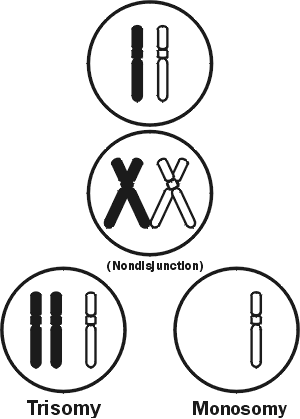
aneuploidy: having one extra or one less chromosome relative to the parental chromosome number.
autosome: any chromosome of a type that is the same in males and females of the species. 


crossing over: at prophase I of meiosis, an interaction in which non-sister chromatids break at corresponding sites and exchange segments resulting a genetic recombination.


deletion: at cytological level, loss of a segment from a chromosome. At molecular level, loss of one to a few base pairs from a DNA molecule.
disease: outcome of infection when defenses aren't mobilized fast enough and a pathogen's activities interfere with normal body functions. 
 
double-blind study: different investigators independently collect, then compare data. 

duplication: gene sequence repeated several to many hundreds or thousands of times. 


genetic abnormality: a rare or less common version of a heritable trait.
genetic disorder: any inherited condition that causes mild to severe medical problems. 
 
genetic recombination: result of any process that puts new genetic information into a DNA molecule (e.g., by crossing over). 


homologous chromosome: one of a pair of chromosomes identical in size, shape, and gene sequence, and that interact at meiosis. 


in-vitro fertilization: conception outside the body (''in glass'' petri dishes or test tubes). 
 
independent assortment: Mendelian theory that by the end of meiosis, each pair of homologous chromosomes are sorted before shipment to gametes independently of how the other pairs were sorted. 
inversion: part of a chromosome that became oriented in reverse, with no molecular loss. 


karyotype: preparation of metaphase chromosomes sorted by length, centromere location, other defining features. 


linkage group: all genes on a chromosome. 
mosaicism: cells of same type express genes differently, so phenotypic differences emerge in same type of tissue. 


Non-disjunction: failure of sister chromatids or a pair of homologous chromosomes to separate during meiosis or mitosis. Daughter cells end up with too many or too few chromosomes. 

polyploidy: having three or more of each type of chromosome in the nucleus of a eukaryotic cell at interphase. 
 
reciprocal cross: a paired cross. In the first cross, one parent displays the trait of interest. In the second, the other parent displays it. 


sex chromosome: a chromosome with genes that affect sexual traits. Depending on the species, somatic cells have one or two sex chromosomes of the same or different type (in mammals, XX females, XY males).
syndrome: a set of symptoms that may not individually be a telling clue but collectively characterize a genetic disorder or disease. 

translocation: of cells, movement of a stretch of DNA to a new chromosomal location with no molecular loss. 


 X chromosome: a type of sex chromosome. An XX mammalian embryo becomes female; an XY pairing causes it to develop into a male. 


Y chromosome: a type of sex chromosome. An XX mammalian embryo becomes female; an XY pairing causes it to develop into a male.


lunes, 14 de marzo de 2011

<>
Chapter 11: Patterns of inheritance
1. allele
One of two or more molecular forms of a gene that arise by mutation and code for different versions of the same trait.
2. codominance
In heterozygotes, simultaneous expression of a pair of nonidentical alleles that specify different phenotypes.
3. continuous variation
Of a population, a more or less continuous range of small differences in a given trait among its individuals.
4. dihybrid cross
An intercross between two F1 heterozygotes that are identical for two gene loci; the dihybrids are offspring of parents that bred true for different versions of two traits.
5. epistasis
Interaction among the products of two or more gene pairs.
6. F1
The offspring of an initial genetic cross.
7. F2
The offspring of parents who are the first filial generation from a genetic cross.
8. gene
Unit of information for a heritable trait, passed from parents to offspring.
9. genotype
Genetic constitution of an individual; a single gene pair or the sum total of an individual's genes.
10. heterozygous
Having a pair of nonidentical alleles at a gene locus (that is, on a pair of homologous chromosomes).
11. homozygous : - dominant
                       
Having a pair of dominant alleles at a gene locus (on a pair of homologous chromosomes).
                    12.  - recessiveHaving a pair of recessive alleles at a gene locus (on a pair of homologous chromosomes).
13. hybrid offspring
Of a genetic cross, offspring having a pair of nonidentical alleles for a trait.
14. incomplete dominance
Condition in which one allele of a pair is not fully dominant; a heterozygous phenotype somewhere between both homozygous phenotypes emerges.
15. independent assortment
Mendelian theory that by the end of meiosis, each pair of homologous chromosomes (and linked genes on each one) are sorted before shipment to gametes independently of how the other pairs were sorted. Later modified to account for the disruptive effect of crossing over on linkages.
16. monohybrid cross
Intercross between two F1 heterozygotes that are identical for one gene locus; offspring of two parents that breed true for different forms of a trait.
17. multiple allele system
Three or more slightly different molecular forms of a gene that occur among individuals of a population.
18. phenotype
Observable trait or traits of an individual that arise from gene interactions and gene-environment interactions.
19. pleiotropy
Positive or negative effects on two or more traits owing to expression of alleles at a single gene locus. Effects may or may not emerge at the same time.
20. probability
The chance that each outcome of a given event will occur is proportional to the number of ways the outcome can be reached.
21. Punnett-square method
Construction of a simple diagram as a way to predict probable outcomes of a genetic cross.
22. segregation
Mendelian theory. Sexually reproducing organisms inherit pairs of genes (on pairs of homologous chromosomes), the two genes of each pair are separated from each other at meiosis, and they end up in separate gametes.
23. testcross
Experimental cross to determine whether an individual of unknown genotype that shows dominance for a trait is either homozygous dominant or heterozygous.
24. true-breeding lineage
Of sexually reproducing species, a lineage in which only one version of a trait appears over the generations in all parents and their offspring