sábado, 9 de julio de 2011

Vocabulary of Concepts of Ch.33 Animal tissue.


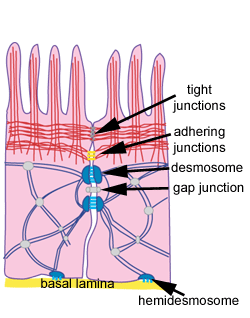
1. adhering junction

Junction where a mass of anchored proteins help adjoining cells adhere.
2. adipose tissue A connective tissue having an abundance of fat-storing cells.
3. blood
Fluid connective tissue of water, solutes, and formed elements (blood cells, platelets). Transports substances to and from cells, helps maintain internal environment.
4. bone tissue
Of vertebrate skeleton, a tissue of osteoblast secretions hardened with minerals.
5. cardiac muscle tissue
A contractile tissue that is present only in the heart wall.
6. cartilage
Connective tissue with solid, pliable intercellular material that resists compression.
7. dense, irregular connective tissue
Animal tissue with fibroblasts, many asymmetrically positioned fibers in ground substance. In skin and some capsules around organs.
8. dense, regular connective tissue
Animal tissue with rows of fibroblasts between parallel bundles of fibers. In tendons, elastic ligaments.
9. ectoderm
The first-formed, outermost primary tissue layer of animal embryos; gives rise to nervous system tissues and integument's outer layer.
10. endocrine gland

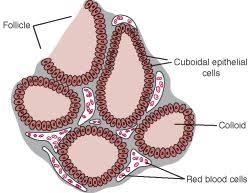
Ductless gland that secretes hormones, which the bloodstream distributes.
11. endoderm
Inner primary tissue layer of animal embryos; source of inner gut lining and derived organs.
12. epithelium
Animal tissue that covers external surfaces and lines internal cavities and tubes. One surface is free and the other rests on a basement membrane.
13. exocrine gland

Glandular structure that secretes products, usually through ducts or tubes, to a free epithelial surface.
14. gap junction
Cylindrical arrays of proteins in the plasma membrane that pair up as open channels for signals between adjoining cells.

15. gland cell
A cell that secretes products unrelated to their own metabolism for use elsewhere
16. homeostasis
State in which physical and chemical aspects of internal environment (blood, interstitial fluid) are being maintained within ranges suitable for cell activities.
17. internal environment
Blood + interstitial fluid.
18. loose connective tissue
Animal tissue with fibers, fibroblasts loosely arrayed in semifluid ground substance.
19. mesoderm
Primary tissue layer of all large, complex animals; gives rise to many internal organs and part of the integument.
20. nervous tissue
Connective tissue composed of neurons and often neuroglia.
21. neuroglia
22. neuron
Type of nerve cell; basic communication unit in most nervous systems.
23. organ
Body structure with definite form and function that consists of more than one tissue.
24. organ system
Organs interacting chemically, physically, or both in a common task.
25. skeletal muscle tissue
Striated contractile tissue that is the functional partner of bone.
26. smooth muscle tissue
Nonstriated contractile tissue found in soft internal organs.
27. tight junction

Cell junction where strands of fibrous proteins oriented in parallel with a tissue's free surface collectively block leaks between the adjoining cells.
28. tissue

Of multicelled organisms, a group of cells and intercellular substances that function together in one or more specialized tasks.

Collectively, cells that structurally and metabolically support neurons. They make up about half the volume of nervous tissue in vertebrates.


Vocabulary of Concepts of Ch.20 Origin and evolution of life.

1. angiosperm
Flowering plant.

2. archaebacterium
Member of the prokaryotic domain Archaebacteria
3. Archean eon
Eon in which life arose (3.8-2.5 bya).

4. big bang
Model for origin of universe.
5. Cenozoic era
The present era (65 mya to present).
6. crust, of Earth
Outer zone of low-density rocks resting on the Earth's mantle.
7. dinosaur


One of a fabulous group of reptiles that originated in the Triassic and became the dominant land vertebrates for 125 million years.
8. Ediacaran
One of the species with a highly flattened body that arose in the precambrian.
9. endosymbiosis theory Continuing physical contact between two species, one of which lives and reproduces inside the other's body.
10. eubacterium
Prokaryotic cell; has a nucleoid, but no nucleus, cytoplasm, or cell membrane; most have a cell wall, some encapsulated.
11. eukaryotic cell
Cell having a nucleus and other membrane-bound organelles.
12. global broiling hypothesis
Theory that an asteroid impact caused the K-T mass extinction by creating a colossal fireball, the debris from which raised global air temperature by thousands of degrees.

13. gymnosperm
Type of vascular plant in which seeds form on exposed surfaces of reproductive structures (e.g., on cone scales).
14. K-T asteroid impact theory
A huge asteroid hit Earth at the K-T boundary; last dinosaurs perished during the mass extinction.

15. mantle


Of mollusks, a tissue draped over the visceral mass. Of Earth, a zone of intermediatedensity rocks beneath the crust.
16. Mesozoic era
An era (240-65 mya) of spectacular expansion in the range of global diversity.
17. Paleozoic era
Era from Cambrian, Ordovician, Silurian, Devonian, Carboniferous, through the Permian (544 to 248 mya).

18. prokaryotic cell
Archaebacterium or eubacterium; single-celled organism, most often walled; lacks the profusion of membranebound organelles observed in eukaryotic cells.
19. Proterozoic eon
Period from 2.5 billion to 570 million years ago; period during which eukaryotic cells arose.
20. protistan
Photoautotroph or heterotroph (or both) unlike bacteria; some like earliest eukaryotic cells. Has a nucleus, larger ribosomes, mitochondria, ER, Golgi bodies, chromosomes with numerous proteins, and cytoskeletal microtubules. Range in size from microscopic algae to giant kelps.
21. proto-cell
Hypothetic cell-like stage between chemical evolution and the first living cell.
22. RNA world
One model for prebiotic evolution in which RNA was the template for protein synthesis before the evolution of DNA.


23. stromatolite
Fossilized mats of shallow-water microbial communities, mainly cyanobacteria, from Archean to precambrian. Cell secretions blocked UV radiation but trapped sediments, and new mats grew on old ones; some are half a mile thick and hundreds of miles across.

Vocabulary of concepts of chs 17, 18, 19


1. analogous structure


Body parts that once differed in evolutionarily distant lineages but converged in structure and function as responses to similar environmental pressures.
2. 


asteroid
Rocky, metallic body, a few to 1,000 kilometers across, hurtling through space.
3. comparative morphology
Scientific study of comparable body parts of adults or embryonic stages of major lineages.

4. derived trait
A novel feature that evolved but once and is shared only by the descendants of the ancestral species in which it evolved.
5. fossil

Recognizable, physical evidence of an organism that lived in the distant past.

6. fossilization
How fossils form. An organism or evidence of it gets buried in sediments or volcanic ash; water and dissolved inorganic compounds infiltrate it; then chemical changes and pressure from accumulating sediments above transform it to stony hardness.
7. geologic time scale
Time scale for the Earth's history with major subdivisions corresponding to mass extinctions. Now radiometrically dated.
8. Gondwana
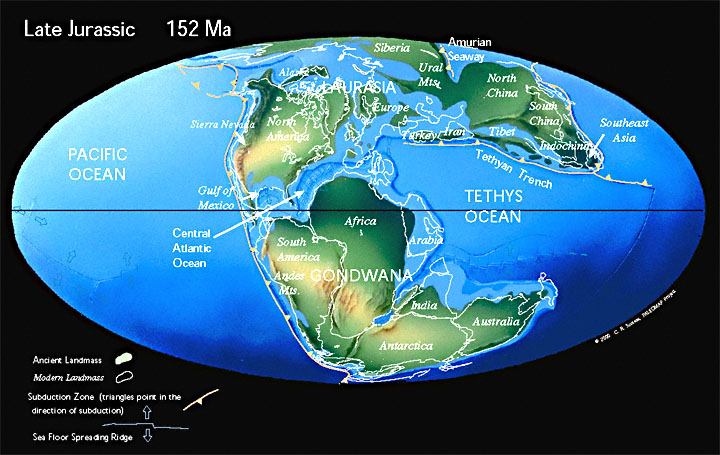
Paleozoic supercontinent; with other land masses, it formed Pangea.

9. half-life
The time it takes for half of a given quantity of any radioisotope to decay into a different, and less unstable, daughter isotope.
10. homologous structure
Of separate lineages, comparable body parts that show underlying similarity even when they may differ in size, shape, or function; outcome of morphological divergence from a shared ancestor.
11. lineage
Line of descent.
12. morphological convergence
Macroevolutionary pattern. In response to similar environmental pressures over time, evolutionarily distant lineages evolve in similar ways and end up being alike in appearance, functions, or both.
13. morphological divergence
Macroevolutionary pattern; genetically diverging lineages undergo change from body form of a common ancestor.
14. Pangea
Paleozoic supercontinent upon which the first terrestrial plants and animals evolved.
15. plate tectonics theory
Theory that great slabs (plates) of the Earth's outer layer float on a hot, plastic mantle. All plates are slowly moving and have rafted continents to new positions over time.
16. stratification
Stacked layers of sedimentary rock, built up by gradual deposition of volcanic ash, silt, and other materials over time.
17. theory of uniformity
Early theory that the earth's surface changes in gradual, uniformly repetitive ways (major floods, earthquakes, and other infrequent catastrophes also occur every year and were not considered unusual). Has since been replaced by plate tectonics theory.
18. adaptive radiation
Macroevolutionary pattern; burst of genetic divergences from a lineage that gives rise to many species, each using a novel resource or a new (or newly vacated) habitat.
19. adaptive zone
Minimum amount of energy required to get a specific reaction going, with or without the help of an enzyme. Reactions differ in the amount required.
20. allopatric speciation
Speciation model. A physical barrier arises, separates populations or subpopulations of a species, ends gene flow, and favors divergences that end in speciation.
21. anagenesis
Speciation pattern; changes in allele frequencies and morphology accumulate within an unbranched line of descent.
22. archipelago
Island chain some distance away from a continent.
23. biological species concept
Defines a species as one or more populations of individuals that are interbreeding under natural conditions, producing fertile offspring, and are isolated reproductively from other such populations. Applies to sexually reproducing species only.
24. cladogenesis
Speciation pattern in which a lineage splits and isolated populations undergo genetic divergence.
25. dosage compensation
Any mechanism that balances gene expression between the sexes during critical early stages of development.
26. evolutionary tree
Treelike diagram; a branch point means divergence from a shared ancestor and branches signify separate lines of descent.

27. extinction

Irrevocable loss of a species.
28. gene flow
Microevolutionary process; alleles enter and leave a population as an outcome of immigration and emigration, respectively.
29. genetic divergence
Gradual accumulation of differences in gene pools of populations or subpopulations of a species after a geographic barrier arises and separates them; thereafter, microevolution occurs independently in each.
30. gradual model of speciation
Idea that species arise by many small morphological changes that accumulate over great spans of time.
31. hybrid zone
Where adjoining populations are interbreeding and producing hybrid offspring.
32. mass extinction
Catastrophic event or phase in geologic time when entire families or other major groups are irrevocably lost.
33. parapatric speciation
Idea that neighboring populations can become distinct species while maintaining contact along a common border.
punctuation model of speciation

Idea that most morphological changes occur in a brief span when populations start to diverge; speciation is rapid, and the daughter species change little for the next 2-6 million years or so.

35. reproductive isolating mechanism
Heritable feature of body form, functioning, or behavior that prevents interbreeding between two or more genetically divergent populations.
36. speciation
The formation of a daughter species from a population or subpopulation of a parent species by way of microevolutionary processes. Routes vary in their details and duration.
37. species

One kind of organism. Of sexually reproducing organisms, one or more natural populations in which individuals are interbreeding and are reproductively isolated from other such groups.
38. sympatric speciation
A speciation event within the home range of an existing species, in the absence of a physical barrier. Such species may form instantaneously, as by polyploidy.